1st Grade Spelling Words: Weekly Lists + Practice Tips
Help your child build confidence with these curated 1st grade spelling words, weekly practice lists, and tips for making spelling fun and manageable at home.
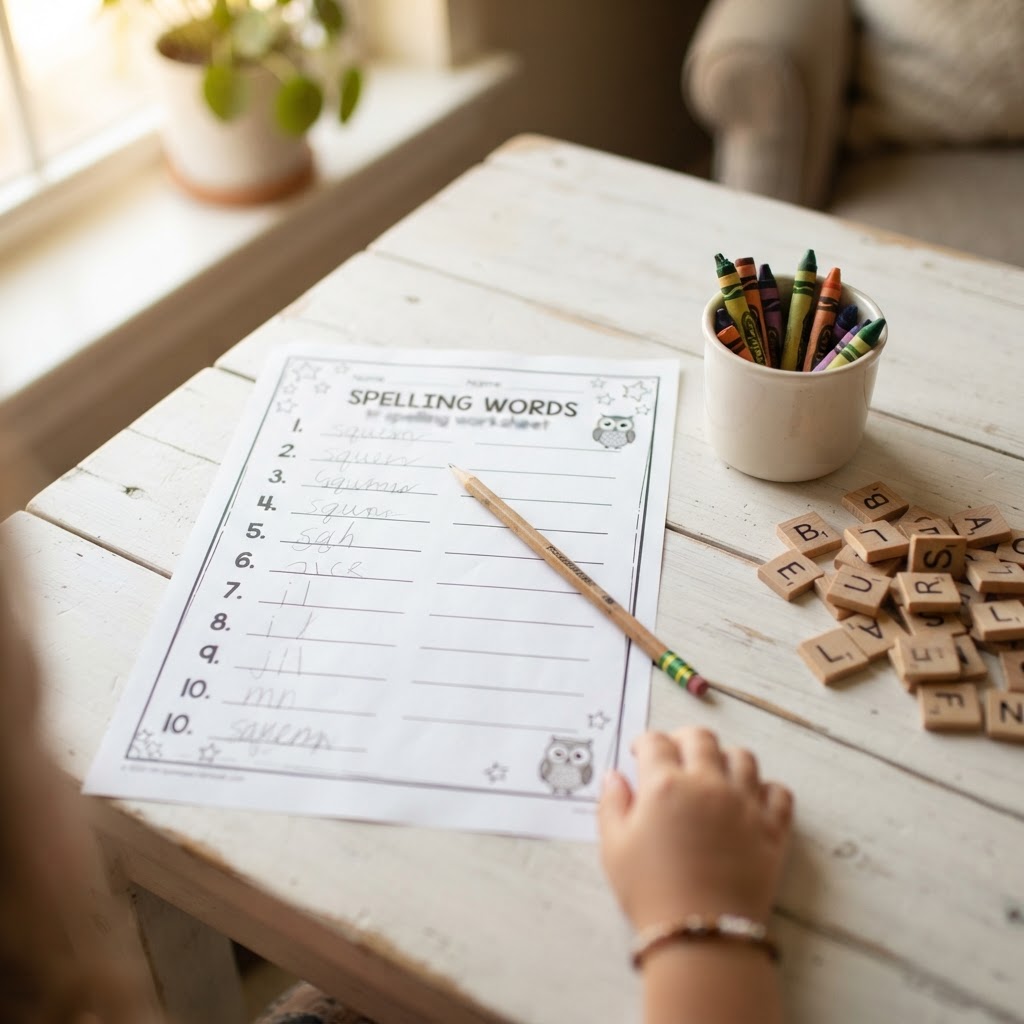
What Are Essential 1st Grade Spelling Words?
1st grade spelling words typically focus on building a strong foundation through short vowel sounds, consonant blends, and high-frequency sight words. By practicing these phonetic patterns consistently, children develop the decoding skills necessary to read and spell more complex words as they progress through the school year. At this age, the goal is not memorization for the sake of a test, but understanding the building blocks of language. I always encourage parents to start with CVC (consonant-vowel-consonant) words before moving into blends and digraphs. If you are looking for a structured way to introduce these, you can download our free 1st Grade Starter Pack to get started immediately.
When we talk about "essential" words, we are looking at two categories: phonetic words and sight words. Phonetic words follow predictable rules (like the short 'a' in 'cat'), while sight words, or "trick words," often defy traditional phonetic rules. Mastering the basics in 1st grade sets the stage for 2nd-grade spelling and beyond. To provide a comprehensive path, I developed the Trace, Write & Spell 1st Grade workbook, which balances these patterns with consistent handwriting practice.
Weekly 1st Grade Spelling Word Lists
Weekly spelling lists for 1st grade are most effective when they follow a specific phonetic pattern rather than being a random assortment of words. The following twelve weeks of lists are designed to move from simple CVC patterns to slightly more complex sounds. By grouping words this way, you help your child identify the underlying logic of the English language.
| Week | Focus | Spelling Words |
|---|---|---|
| 1 | Short 'a' | cat, map, bat, sad, fan, cap, tap, mad, dad, rat |
| 2 | Short 'i' | pig, bin, sit, fix, wig, lip, hit, dim, win, six |
| 3 | Short 'o' | dog, hot, pot, mop, log, box, fox, top, hop, cot |
| 4 | Short 'u' | sun, bug, nut, run, cup, hug, mud, tub, gum, rug |
| 5 | Short 'e' | bed, hen, net, pet, leg, men, ten, red, jet, wet |
| 6 | 'sh' Digraph | she, ship, fish, shop, shut, wish, dish, dash, cash, shed |
| 7 | 'ch' Digraph | chip, chat, chin, rich, much, chop, such, path, bench, lunch |
| 8 | 'th' Digraph | that, thin, this, math, with, bath, them, path, moth, thick |
| 9 | 'st' Blends | stop, star, step, fast, last, mast, mist, dust, nest, best |
| 10 | 'fl' Blends | flag, flip, flat, flap, fled, fly, flash, floss, fling, flame |
| 11 | 'bl' Blends | blue, blob, bled, blur, blip, black, block, blast, blink, blush |
| 12 | 'ck' Ending | back, deck, kick, lock, duck, sack, neck, sick, rock, luck |
How to Help Your Child Practice Spelling at Home
To help your child practice spelling, prioritize short, frequent sessions rather than long, stressful drills that cause burnout. Creating a consistent routine is the most effective way to help them retain new patterns and feel prepared for their weekly spelling checks. Children this age benefit immensely from "muscle memory"—the physical act of writing letters connects their brains to the formation of the word.
I recommend following a 5-day study plan that breaks the list into manageable chunks. You might focus on writing the words on Monday, using magnetic letters on Tuesday, and playing a verbal spelling game on Wednesday. Our Trace, Write & Spell 1st Grade workbook provides a structured path for these daily exercises, helping children focus on letter formation and spelling simultaneously.
If you prefer a digital approach, our web app, Spelling Test Helper (spellingtesthelper.com), allows you to type in these exact lists to generate audio practice and interactive games. When you use the app, your child hears the word pronounced and sees it on the screen, creating a multimodal learning environment. You can try it out with a free 14-day trial (no credit card needed).
The Power of Multisensory Spelling Techniques
Many parents ask me how to keep 1st graders engaged when they are tired after a long day of school. The answer is multisensory learning. Instead of just staring at a list on a piece of paper, encourage your child to engage their senses.
- Sand Trays: Pour a thin layer of salt or sand on a cookie sheet. Have your child "write" their spelling words with their finger. The tactile feedback of the grains against their skin is a powerful memory anchor.
- Air Writing: Have your child stand up and write the letters of their spelling words in the air using their entire arm. This "big movement" engages their gross motor skills, which helps them remember letter shapes much better than just using a pencil.
- Magnetic Letters: Build the words on the refrigerator. When you move the physical letters to form the word "ship," the child understands that the 's' and the 'h' work together as a team.
- The Spelling Test Helper Advantage: Our web app automates the auditory aspect of this. By typing in your child's weekly list, you ensure they are hearing the words pronounced clearly while practicing spelling games, quizzes, and even our "spelling bee mode." This is a fantastic way to offload the repetitive "testing" part of the week so you can focus on encouragement.
Making Spelling Fun With Games
Spelling practice doesn't have to be limited to paper and pencil; games are a fantastic way to engage 1st graders who are just learning to write. By turning spelling into play, you reduce the pressure and help your child associate learning with positive emotions. When a child enjoys the process, they stop viewing spelling as a chore and start viewing it as a challenge.
Try these simple activities at home:
- Spelling Hopscotch: Write letters in chalk on the sidewalk and have your child jump to each letter to spell their words. This is excellent for kinesthetic learners.
- Hidden Words: Hide written words around the room and have them go on a scavenger hunt to find and spell them aloud.
- Spelling Bee Mode: Using the Spelling Test Helper app, you can simulate a friendly spelling bee that gamifies the experience for your child. It acts as a neutral coach, allowing you to cheer from the sidelines rather than being the "test-giver."
- Word Dice: Write individual letters on wooden blocks or dice. Roll them and see if your child can form one of their spelling words from the letters they rolled.
Understanding Spelling Patterns vs. Sight Words
First grade requires a balance between learning phonetic spelling patterns and memorizing common sight words that don't always follow the rules. While patterns like 'sh' or 'th' help with decoding, sight words like 'the', 'said', or 'was' require a different approach for mastery.
I often advise parents to treat sight words as "photographs." We don't sound them out; we memorize what they look like as a whole. You can make this fun by having a "Word Wall" in your kitchen. Use post-it notes to place sight words on the wall, and ask your child to touch and say the word whenever they walk past.
For the phonetic patterns, remind your child that they are like codebreakers. When they see 'ch', they know it makes a specific sound. This empowerment helps them tackle new, longer words. For students who need extra handwriting and spelling practice to reinforce these rules, our full collection of workbooks covers the progression from Pre-K through 4th grade. Please note that our workbooks are approved for Texas Education Freedom Accounts (TEFA). If you are a Texas family, you can purchase these materials using EFA funds on the Odyssey marketplace.
Integrating Spelling into Daily Life
You don't need a formal "school" environment to teach spelling. Some of the best learning happens in the gaps of your day. Here are a few ways to integrate 1st-grade words into your routine:
- Grocery Store Spelling: Ask your child to find a word on a package that contains the "short a" sound they practiced that week.
- Bedtime Story Dictation: After reading a book, pick one sentence and ask your child to spell one simple word from that sentence, like "cat" or "pig."
- The "Spelling Test Helper" Routine: Before dinner, set up the web app to run a 5-minute practice session. Because it’s interactive, it feels like screen time, but it’s actually reinforcing their curriculum.
Remember that progress in 1st grade is often non-linear. One week your child may breeze through the 'sh' digraphs, and the next week they might struggle with 'ck' endings. That is perfectly normal. Our full-year workbooks are designed to provide enough repetition that these skills eventually stick. If you aren't sure which level your child needs, you can download the free 4-week starter packs for any grade level to test the waters.
Tips for Managing Spelling Anxiety
If your child feels anxious about spelling, focus on effort and progress rather than achieving a perfect score. Building confidence starts by celebrating the words they got right, especially those with tricky vowel sounds or blends. Anxiety often stems from a fear of being "wrong." I always tell parents to reframe the spelling mistake as a "discovery." If a child spells "ship" as "sip," instead of saying "that's wrong," try saying, "I see you remembered the 's' and the 'p'! You just missed the 'h' sound that joins the 's'. Let's add that buddy in there."
Keep these tips in mind:
- Keep it short: Aim for 10–15 minutes of practice maximum. A tired brain cannot store new spelling patterns effectively.
- Use multisensory tools: Use sand trays, whiteboard markers, or even typing to make the movement of spelling more engaging.
- Be patient: Spelling is a developmental skill, and every child moves at their own pace. Some children are naturally visual, while others need to hear the sounds many times.
- Focus on the Process: Use the Spelling Test Helper app to take the "test" out of the equation. By allowing the app to handle the audio and feedback, you remove the interpersonal friction that can sometimes occur when a parent is grading their own child.
- Celebrate Small Wins: If they master the 'th' digraph this week, celebrate it! Put a sticker on their workbook or let them choose a special activity. Positive reinforcement is the best tool in your teaching kit.
With consistent support, a variety of practice methods, and the right tools—like our workbooks or our web app—your child will gain the confidence to become a strong, independent speller. Remember, you are your child's first and most influential teacher. By keeping the atmosphere warm and the practice sessions bite-sized, you are laying the foundation for a lifetime of literacy.
Frequently asked questions
How many 1st grade spelling words should a child learn per week?+
Most 1st grade programs introduce between 8 and 12 words per week. It is best to focus on a specific phonetic pattern, such as short vowels or digraphs, to help the child recognize structures.
How can I help my 1st grader if they struggle with spelling?+
Focus on multisensory learning like writing in sand, using letter tiles, or playing spelling games. You can also use our web app to create custom audio practice, which helps children who learn better by hearing and then writing the words.
Are your spelling workbooks suitable for homeschoolers?+
Yes, our workbooks are designed for parents and teachers alike, providing a full-year curriculum that covers both spelling and handwriting. They are perfect for homeschool families who want a straightforward, easy-to-implement program.
Can I use Texas EFA funds for these spelling materials?+
Yes, our Trace, Write & Spell workbooks are approved for Texas Education Freedom Accounts (TEFA). You can purchase them using your EFA funds directly through the Odyssey marketplace.
Texas EFA approved spelling and handwriting workbooks
Our Trace, Write & Spell workbooks are approved for the Texas Education Freedom Accounts (TEFA) program. Texas families can buy them with their EFA funds on the Odyssey marketplace, then print at home. Each one is a full-year, TEFA approved spelling and handwriting curriculum for Pre-K through 4th grade.
- Pre-K to K: Pre-Writing, Letters & Sounds ($9.99)
- Kindergarten: Spelling & Handwriting ($29.90)
- 1st Grade: Spelling & Handwriting ($34.90)
- 2nd Grade: Spelling & Cursive ($34.90)
- 3rd Grade: Handwriting & Spelling ($34.90)
- 4th Grade: Spelling & Cursive ($34.90)
Not in Texas? Anyone can buy the workbooks directly on our site.

About the author
Lilly is the founder of Spelling Test Helper and creator of the Texas EFA approved Trace, Write & Spell workbooks, made to help families turn weekly spelling lists into confident spellers.